

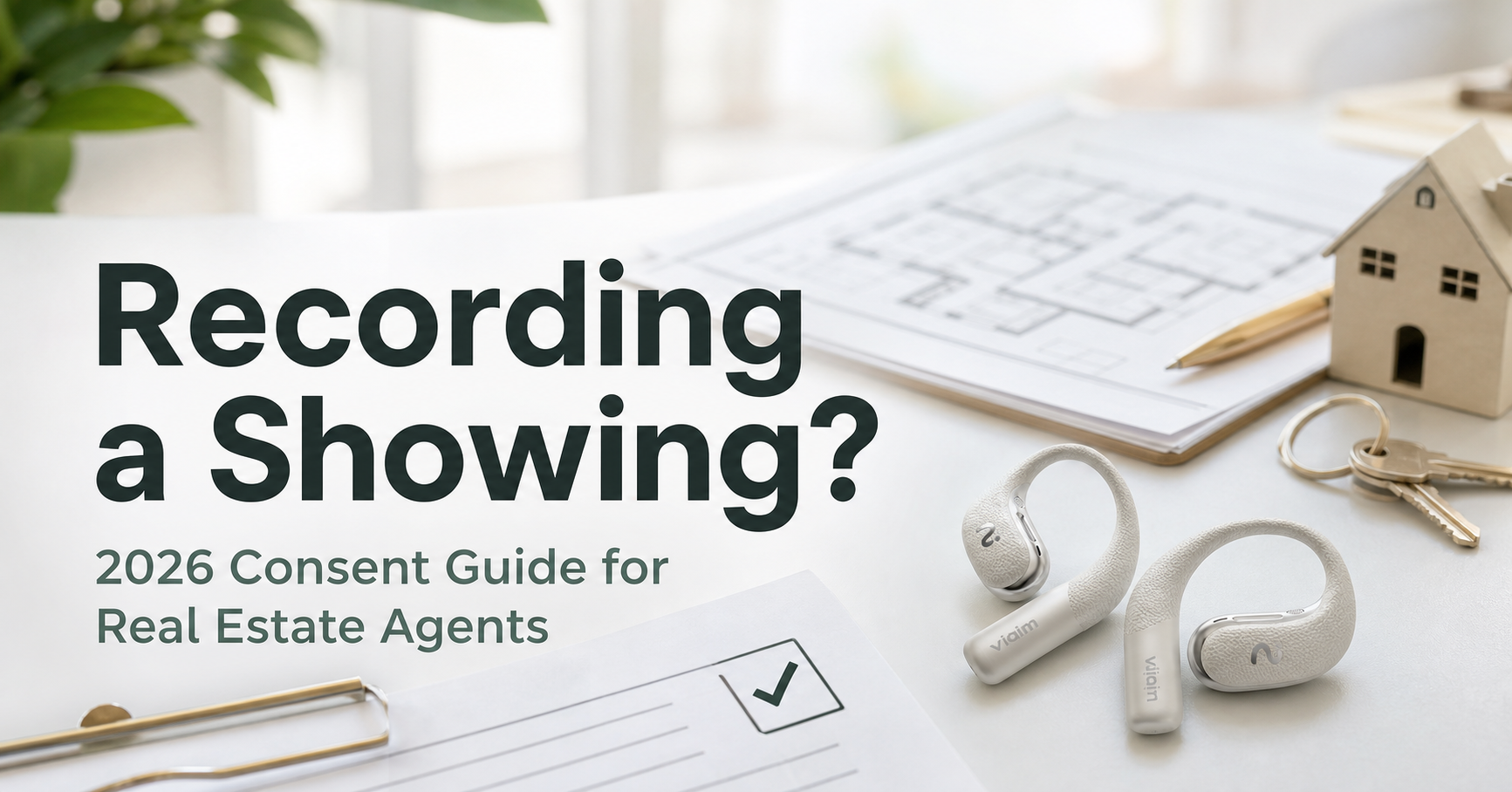
Short answer: recording a real estate showing or client call is often legal when you are part of the conversation, but the safest professional rule is simpler than the legal map: tell people first, get consent, then record.
Recording can make you a sharper real estate agent. It helps you capture buyer preferences, listing details, follow-up tasks, financing concerns, and exact wording that would otherwise disappear after a busy day of showings. But real estate conversations are also unusually sensitive. They happen in homes, involve private financial and family information, and often include buyers, sellers, tenants, spouses, contractors, and other agents.
That is why recording-consent law matters. Federal law generally allows one-party consent, but state law can be stricter, and state rules do not always fit neatly into a simple one-party vs. two-party chart. This 2026 guide explains the practical rules real estate agents should know before recording showings, listing appointments, buyer consultations, Zoom calls, or phone calls. It builds on the general, industry-agnostic breakdown in our companion guide, Is It Legal to Record a Meeting? U.S. State Laws Explained (2026), but focuses specifically on the situations real estate agents run into: occupied homes, showings, and cross-state buyers.
This article is general information, not legal advice. Recording statutes change, courts interpret them differently, and your brokerage, MLS, seller instructions, or local association rules may be stricter than state law. Before making recording part of your workflow, verify current law in your state and consult your broker or a qualified attorney.
Last reviewed: July 27, 2026.
Quick Answer for Real Estate Agents
- Federal law is usually one-party consent. Under 18 U.S.C. Section 2511, a participant can generally consent to recording a conversation, unless the recording is made for a criminal or tortious purpose.
- State law can be stricter. Some states require everyone on a call or private conversation to consent. Others have mixed rules depending on whether the conversation is in person, by phone, electronic, or in a private place.
- Showings create extra privacy risk. A buyer tour can happen inside someone else's home, while sellers, tenants, family members, or other visitors are nearby. Avoid capturing people who have not agreed to be recorded.
- Cross-state calls are risky. If anyone is in a stricter consent state, follow the stricter rule. California's Kearney v. Salomon Smith Barney decision is a well-known warning for calls involving California.
- Best universal practice: ask before every recording, start recording only after consent, and stop if anyone objects.
One-Party vs. All-Party Consent, in Plain English
One-party consent means one participant in the conversation can consent to the recording. If you are speaking with the client, you are usually a participant, so your consent may satisfy federal law and many state laws.
All-party consent means every participant must know about and agree to the recording. People often call this "two-party consent," but that phrase is misleading. In a buyer consultation with spouses, parents, a lender, and an agent, "all parties" means every person whose private conversation is being captured.
For real estate work, the practical difference is simple:
- In a one-party state, you might legally record your own client conversation without announcing it, but doing so can still damage trust or violate brokerage policy.
- In an all-party or mixed-rule state, secret recording can create criminal, civil, evidentiary, or licensing problems.
- In any state, recording inside an occupied home or near people who are not part of your client conversation can create privacy issues beyond ordinary phone-call consent rules.
States Where Agents Should Be Extra Careful in 2026
Many online guides say there are exactly 12 all-party consent states. That shortcut is useful for memorization, but it can be too blunt for real estate. Several states have mixed rules: phone calls may be treated differently from in-person conversations, or statute text and court interpretation may not line up cleanly.
Use the table below as a risk map, not as a substitute for legal advice. If a client, seller, tenant, or co-agent is in one of these states, ask for consent before recording.
| State | Agent-friendly practical rule | Why it matters |
|---|---|---|
| California | Get consent from everyone before recording confidential calls or conversations. | California has strong all-party consent rules, and calls involving California can trigger California law even when the other party is elsewhere. |
| Connecticut | Get all-party consent for phone/electronic calls; verify before relying on different in-person rules. | Connecticut is often treated as mixed because telephone recording rules are stricter than some in-person situations. |
| Delaware | Treat private conversations and calls as requiring all-party consent unless counsel confirms otherwise. | Delaware law is commonly described as conflicting or unclear because privacy and wiretap provisions point in different directions. |
| Florida | Get everyone's consent before recording private oral, wire, or electronic communications. | Florida is one of the clearest stricter-consent states for private communications. |
| Illinois | Get consent before recording private conversations or electronic communications. | Illinois eavesdropping law focuses on private conversations and can create serious consequences for unauthorized recording. |
| Maryland | Get all-party consent before recording client calls or private conversations. | Maryland is generally treated as an all-party consent state for real estate call-recording purposes. |
| Massachusetts | Do not secretly record. Announce and get consent first. | Massachusetts is especially strict about secret recordings, even when the recorder participates in the conversation. |
| Montana | Announce the recording and make sure everyone knows before using a recording device. | Montana's privacy rule focuses on hidden devices and whether parties know a private communication is being recorded. |
| Nevada | Get all-party consent for calls; verify separately for in-person conversations. | Nevada is often described as mixed: in-person rules are more permissive, but wire/phone recording rules are stricter. |
| New Hampshire | Get everyone's consent before recording private conversations or calls. | New Hampshire is generally treated as an all-party consent state. |
| Oregon | For showings and in-person conversations, inform everyone before recording; phone/electronic rules can differ. | Oregon is mixed: in-person oral conversations are treated differently from certain electronic communications. |
| Pennsylvania | Get all-party consent before recording calls or private conversations. | Pennsylvania is generally treated as an all-party consent state. |
| Washington | Get everyone's consent before recording private communications. | Washington requires consent for private communications and has specific rules for recorded consent on calls. |
What about every other state? Most other states generally follow one-party consent for participant recordings, but that does not mean "record anything." Private-place rules, hidden-camera rules, harassment laws, criminal-purpose exceptions, brokerage policies, MLS rules, seller instructions, and professional ethics can still limit what you should record.
The Cross-State Trap
Real estate frequently crosses state lines. You might be in Texas, your relocation buyer might be in California, the listing agent might be in Oregon, and the seller might be traveling in Florida. In that situation, relying only on your own state's one-party rule is risky.
The best-known example is Kearney v. Salomon Smith Barney, a California Supreme Court case involving calls between California clients and Georgia employees. The court held that California's stricter privacy law could apply to calls involving California residents, even though Georgia allowed one-party consent.
For agents, the practical takeaway is easy: if any person on the call is in a stricter or mixed-consent state, use the stricter rule and get everyone's consent.
Recording Inside Someone's Home: Why Showings Are Different
A showing is not the same as a normal office meeting. You may be standing inside a seller's or tenant's home, talking with a buyer, while other private conversations are happening nearby. That creates a privacy layer that many generic recording-law guides miss.
- Buyer tours: If you want to record your conversation with a buyer, tell the buyer first and get their permission. In stricter states, consent is required; in one-party states, it is still the more professional habit.
- Occupied listings: If a seller, tenant, child, guest, or roommate is home, avoid recording anything that could capture their private conversation unless they have agreed.
- Open houses: Open houses are messy for consent because visitors can enter and leave constantly. Continuous ambient recording is risky unless the event is clearly noticed and managed under local rules.
- Seller cameras: A seller's doorbell camera or interior camera does not automatically give you permission to record your own audio. Treat your recording as a separate legal act.
- MLS and brokerage rules: Even if state law allows a recording, your MLS, broker, seller instructions, or showing platform rules may not.
A Consent Script Agents Can Use
You do not need to make the moment awkward. The best consent request is short, service-oriented, and recorded only after the person says yes.
"To make sure I capture your preferences accurately and don't miss any follow-up items, I use a note-taking tool that records our conversation. Is that okay with you?"
For a call with multiple people, make it explicit:
"Before we start, I'd like to record this call so I can create accurate notes and next steps afterward. Is everyone comfortable with that?"
If someone says no, do not argue. Use written notes or an unrecorded summary instead.
How to Record Responsibly as a Real Estate Agent
1. Ask before every recording
A repeat client saying yes last month does not automatically mean they consent today. Make consent part of your opening routine.
2. Start recording after consent, not before
Use a tool you can start on demand. This avoids capturing the pre-consent part of the conversation. If you are still deciding what kind of device fits your workflow, our comparison of AI earbuds vs. AI voice recorders walks through the trade-offs between a wearable, on-demand earbud and a traditional standalone recorder.
3. Use written consent for high-stakes conversations
For listing agreements, offer negotiations, inspection disputes, commission conversations, or financial discussions, a short written consent line in an email, intake form, or meeting confirmation is safer than relying on memory.
4. Record only what you need
Pause or stop during side conversations, family discussions, sensitive financial details, or any moment a client asks you not to capture.
5. Protect the recording afterward
A recording can include financial details, health needs, family plans, access codes, relocation timelines, and negotiation strategy. Store files securely, limit sharing, and follow your brokerage's retention policy. Once a recording is properly consented to and transcribed, the next step is usually getting those notes out of the recording and into your pipeline; see Real Estate Agent Follow-Up: From Showings to CRM for how to turn a showing transcript into a same-day follow-up instead of a forgotten voice memo.
6. Separate transcription from permission
An AI transcript or meeting summary does not change the legal question. If audio is being captured, consent rules still matter.
Where a Consent-Forward Tool Helps
The right device cannot make an illegal recording legal. Consent is an action you take, not a feature you buy. But the right workflow can make compliant behavior easier.
A visible, on-demand AI note-taking earbud such as viaim RecDot can support a consent-first routine because you can announce the recording, get agreement, then start capture with one tap and review the transcript afterward. The open-ear viaim OpenNote can be helpful on longer showing days when comfort and awareness matter. You can compare models on the viaim product comparison page. For the fuller picture of where note-taking earbuds fit alongside your CRM, listing tools, and lead scoring, see 10 Best AI Tools for Real Estate Agents in 2026.
Visibility helps transparency, but it is not the same as consent. The safest habit is still: ask, wait for yes, then record.
Can You Use a Recording as Evidence Later?
Sometimes agents record because they want protection if a client later disputes what was said. That instinct is understandable, but an illegally made recording can backfire. Depending on the state and the proceeding, it may be inadmissible, expose you to civil damages, create criminal risk, or raise licensing and brokerage issues.
If you are recording specifically to preserve evidence, use clear consent and ask your attorney how to do it properly.
FAQ
Is it legal for a real estate agent to record a client?
Often yes, if the agent is part of the conversation and the applicable law allows one-party consent. But in all-party or mixed-consent states, everyone may need to agree. The safest professional practice is to ask for consent every time.
Can I record a buyer during a property tour?
You may be able to record your own conversation with the buyer, but you should tell the buyer first. Avoid recording sellers, tenants, family members, or other visitors inside the home unless they have clearly agreed.
Can I record a listing appointment?
Yes, if you get proper consent under the applicable law and brokerage rules. Because listing appointments often include pricing, finances, personal timelines, and commission discussions, written consent is a smart extra step.
Do I need written consent, or is verbal consent enough?
Verbal consent is often enough when clearly captured at the start of the recording, but written consent is better for high-stakes or sensitive conversations. Some state laws have specific notice or consent requirements, so verify locally.
What if my client is in another state?
Follow the stricter rule if any participant is in a stricter or mixed-consent state. Cross-state calls are one of the biggest reasons agents should use a universal consent-first routine.
Are AI note-taking earbuds legal for real estate agents?
The device itself is not the main issue. The key question is whether you are legally allowed to capture the conversation. Use AI note-taking earbuds only after telling participants and getting consent.
Can a seller record audio during a showing?
Seller surveillance is a separate but related issue. Video cameras and audio recording are treated differently in many states. Agents should check seller instructions, MLS rules, brokerage policy, and local law before assuming audio recording is allowed.
What should I do if someone refuses to be recorded?
Do not record. Take written notes, send a recap email afterward, or use a non-recording task list. Refusal should be treated as the end of the recording discussion.
Source Notes
This guide was reviewed against federal recording law, state recording-law surveys, and selected official state statutes. Useful starting points include 18 U.S.C. Section 2511, the Reporters Committee state recording guide, Justia's 50-state recording survey, California's Kearney decision, Oregon ORS 165.540, Nevada NRS Chapter 200, Delaware privacy law, and Montana MCA 45-8-213.
The Bottom Line
Recording can make you a more attentive and organized real estate agent, but the legal map is too uneven for casual assumptions. Some states are one-party, some are all-party, and several are mixed depending on whether the conversation is by phone, in person, electronic, or inside a private place.
The best habit works everywhere: tell people you want to record, explain why, get consent, and start recording only after they agree. That protects your clients' trust, keeps your workflow professional, and still gives you the accurate notes and follow-up that recording is meant to provide.


Share:
Best AI Tools for Sales Teams in 2026: A Complete Guide
Best AI Headphones for Meetings in 2026: Buyer's Guide